

President Toroama congratulates Kokoda Constituency for being Independence-Ready
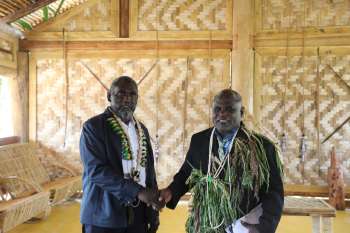
His Excellency President Ishmael Toroama witnessed the Kokoda Constituency’s declaration of being independence-ready, with other members of the Autonomous Bougainville Government, partners from the Solomon Islands and the people of Kokoda Constituency yesterday.
While addressing the people at the event, President Toroama urged citizens to be responsible for their social behavior as they continue to develop their constituency, now that they have declared themselves independence-ready.
“No one else will come and control you; we have to be responsible in the act and the manner that we are prepared to go into. I want to congratulate you for being independence ready. I want to reiterate that we (Autonomous Bougainville Government) continue to stand and bring this idea to all the constituency members in the House of Representatives and the members of the National Parliament; let us work together.”
His Excellency has pledged to build a level two hospital and a police station in the Kokoda Constituency to further boost the institution that they currently have.
“Today I want to say thank you and congratulate the Member for Kokoda Constituency, Honorable Member, Philip Pinaung. I want to say that the government stands with you and is ready to progress the work in the Kokoda Constituency, the work that has happened and those that will happen in the next year. The Government is placing K20million on the road to develop a level 2 hospital at Toimanapu and a police station that will be built here (Kerekere),” President Toroama said.
He reminded the people of Kokoda that the Autonomous Bougainville Government has held the people’s dream for independence in high regard and dialogued with the Papua New Guinea Government only for independence and no other options.
“We have consulted for a result, which is independence; we did not consult for the highest possible autonomy; we consulted for independence. The talks we had, the government stood with you. Because a leader must stand to protect your rights, the ideology and dreams of the people of Bougainville in the past and now the present.”
His Excellency also acknowledged the ex-combatants who fought for Bougainville during the conflict and now play a vital role in redevelopment in their communities and constituency.
“Leadership of the ex-combatants, I want to say thank you for your support; the support that the community brings with the general public is tremendous. Working together as we stand to pave a way that we can exercise our right.”
As Bougainville progress towards the target date for self-governance and independence, the region’s economy remains the greatest challenge. His Excellency stressed the importance of redeveloping the Panguna Mine to jumpstart the economy before independence.
“The biggest challenge the government has faced in the fourth and current House is on how to build the economy. I stand today and mention Panguna Lloyds Metal, who is our partner in redeveloping Panguna Mine; we also have Island Passage, which has come to complete explorations, and if we go into actual mining, we can look at those areas.”
He stressed that being independent and ready is everyone’s responsibility.
“Fathers, mothers, you are responsible; civil society, you are all responsible. We are responsible for this declaration. Youth leaders, you are responsible for the way your youths behave and socialize; it is your responsibility. Ward members, it is your responsibility; we have our constituency members who stand to implement the vision for an independence-ready mission. Today I want to say that we will not back down from the comments made by people who tell us that we are not ready. Bougainville, we are ready! We are ready to declare Self-Government on the first of September 2027.”
[ Back to News ]